Reflections On My First Fifty Years Within Classical Japanese Martial Traditions
 | “Old pine tree on a rock from long long ago. Even when the snow falls, the color of the needles does not change.” —Araki-ryu torite-kogusoku “An integrated body is the merging of an immovable mind and moving mind. Because the will has experienced an awakening, it is upright and not confused.” —Tenshin Bukō-ryū |
|
Original 🇺🇸 & Translation in 🇫🇷 🇨🇿 Upcoming translations in 🇪🇸 🇮🇹 🇩🇪
The Martial Arts Podcast #26 – On Roots Still Cracking Rock
 or
or 
Hardbound, Soft Cover, eBook and on the Ran Network Site, a Special Dedication Edition for Dojo & Other Groups

🇫🇷 🇨🇿
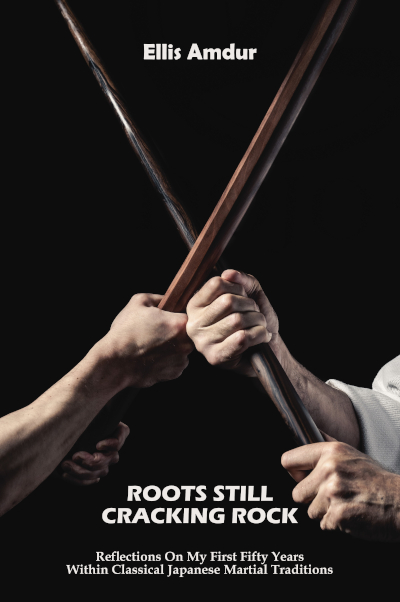
Fifty years ago, Ellis Amdur undertook the difficult task of a full commitment to two Japanese martial traditions, each eighteen generations deep. As one can see even from these two brief quotations, they are fundamentally different in character, even when expressing much the same principle. He felt the tremendous weight of responsibility that he do justice to what had been bequeathed to him, keeping them absolutely separate. As he put it, “When I am in my Araki-ryū dōjō, Bukō-ryū does not exist; when I am in my Bukō-ryū dōjō, Araki-ryū does not exist.” And he follows, “In any live situation, be it training or something more serious, they mix together as they choose. It is as if I have two lives within me, and they figure out their own working relationship.”
“Roots Still Cracking Rock is Amdur’s most personal book on martial arts. It reflects his lifelong struggle to be upright and not confused, an old pine tree whose needles do not change color, despite the snow.
Ellis Amdur has been a friend and colleague for 25 years. I have long appreciated his numerous treatises on Japanese classical martial traditions. Often provocative, Ellis sweeps away the veil of romanticism and reminds the reader that, at its core, koryū bujutsu is the study of conflict and violence tempered by Japanese etiquette, mindset and cultural evolution. He also adeptly addresses kata (pattern training) and shiai (freestyle combat), difficult subjects seldom represented with such intricate clarity. Whether you’re a student holding a sword or a scholar holding a pen, this comprehensive collection of essays challenges common assumptions and deepens one’s understanding of an arcane pursuit, one that remains frequently inaccessible to outsiders. Among all his books, it is this one that I believe to be most informative to students of Japanese martial arts. I will enthusiastically recommend this volume to the greater membership of the koryū ryūha I lead”.
—Tobin Threadgill
Menkyo-Kaiden/Kaichō Takamura-ha Shindō Yōshin Kai